
Distorting Your Audio With Intent — The Culture Vulture Approach
Posted by Jim Pavett on 6th Apr 2025
One thing I tell every student who comes through my studio: if something is happening in your audio, it should be because you chose to make it happen. Not because you stumbled into it. Not because you did not know how to prevent it. Because you understood what was happening and decided it served the song.
Distortion falls squarely into that category.
The Paradox of Distortion
We spend most of our time as engineers working against distortion. Gain staging. Headroom management. Signal to noise ratio. The entire discipline of recording is largely an exercise in keeping your signal clean and controlled from source to storage.
And then there are moments when the cleanest, most technically correct mix still feels like something is missing. It sits flat. It lacks density. It does not move the way it should.
That is when I reach for distortion — deliberately, intentionally, with a specific result in mind.
Not All Distortion Is Created Equal
The word distortion covers an enormous range of sonic territory. On one end you have subtle tape saturation — a gentle rounding of transients, a slight harmonic richness that adds warmth and density without announcing itself. On the other end you have the sound of a circuit failing — aggressive, harmonic, ugly in the best possible way on the right source.
I use them differently.
For compression-style thickening — adding weight and body to a mix bus, a drum bus, or a vocal — I want smooth distortion. Tape character. The kind of saturation that makes things feel bigger without making them feel broken. Applied at low levels it functions more like compression than distortion — it controls dynamics while adding harmonic content simultaneously.
For specific instruments — a guitar that needs more edge, a synth that needs to cut through, a drum that needs more aggression — I am more open to nastier distortion characteristics. Circuit saturation, transformer overdrive, tube breakup. These add character that smooth distortion cannot.
The key in both cases is intent. I know what I want before I reach for the tool. I am not turning knobs hoping something good happens.
The Culture Vulture
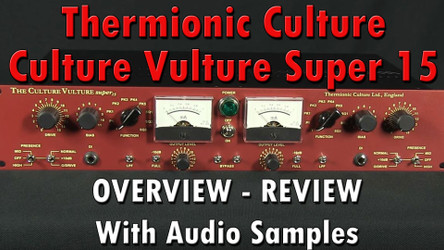
The piece of gear I reach for most when distortion is the answer is the Thermionic Culture Culture Vulture. It is one of the most versatile and musical distortion devices ever built — capable of everything from barely perceptible tape warmth to full harmonic destruction depending on how you drive it.
What makes the Culture Vulture different from most saturation tools is the range and control of its distortion character. Triode, pentode, and tetrode tube modes each have a completely different sonic signature. The amount of drive, the tube type, and the output level interact to create an almost infinite palette of harmonic color.
I made a video running through all the different settings of the Culture Vulture on a stereo mix — if you want to hear exactly what it does across its full range before making a decision, this is the most honest demonstration I know of.
Watch the Culture Vulture demo on YouTube
When to Use It
Distortion is not a rescue tool. It will not fix a bad recording or a poorly arranged mix. What it will do is add dimension, density, and character to something that is already working but needs one more element to feel complete.
I use it on:
- Mix bus — subtle drive to add density and glue
- Drum bus — low to mid drive for aggression and weight
- Individual instruments — vocals, guitars, synths — when the source needs more character
- Parallel processing — blend distorted signal with clean for weight without loss of definition
The most important rule: use your ears, not the meters. Distortion is a hearing decision, not a technical one. When it sounds right, it is right. When it sounds like a mistake, back off.
Thermionic Culture at Pure Wave Audio
The Culture Vulture and the full Thermionic Culture lineup are available at Pure Wave Audio. These are handbuilt British tube devices — not mass produced gear. If you want to talk through which Thermionic Culture product fits your setup, hit reply.