
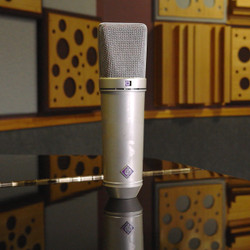
The Neumann U67 — Why This Microphone Is Still the Holy Grail
Posted by Jim Pavett on 20th May 2026
I have owned my Neumann U67 for 28 years. It has been the primary microphone at my studio for most of that time. I have tracked vocals through it on Grammy-nominated sessions, recorded acoustic guitar on major label projects, and reached for it on everything from brass to strings to room ambience when I needed the recording to be exactly right.
In nearly three decades of daily use, nothing has replaced it.
That is not nostalgia talking. That is 40 years of commercial studio engineering and a B.S. in Electrical Engineering telling you that the U67 does something no modern microphone has fully replicated. Understanding why requires understanding what Neumann actually built in 1960.
What Makes the U67 Different
The U67 was introduced as the successor to the legendary U47 — which is no small statement. Taking over from the U47 was one of the most pressure-filled product launches in the history of studio microphones. Neumann didn't just meet the bar. They raised it.
At the center of the U67 is the K67 capsule — the foundation of what engineers still call the "Neumann sound." The tube circuitry incorporates a pre-emphasis and de-emphasis scheme specifically designed to minimize tube hiss, which was a revolutionary approach at the time. The result is a tube microphone that is remarkably quiet — not in spite of its tube design but because of how intelligently that design was executed.
Three selectable polar patterns — omnidirectional, cardioid, and figure-8 — give the U67 a versatility that most microphones at any price point still can't match. A switchable low-cut filter compensates for proximity effect. A pre-attenuation pad handles sound pressure levels up to 124 dB without distortion. For 1960, this was engineering that was decades ahead of its time.
What It Actually Sounds Like
Describing the U67 in technical terms only gets you so far. What you need to know is what it does to a voice or an instrument when you put it in front of one.
On vocals, the U67 has a smooth top end with a subtle tube shimmer that flatters without coloring. It does not add harshness. It does not exaggerate sibilance. It captures the full weight and body of a voice and translates that onto tape — or into your DAW — with a realism that makes most modern condensers sound thin by comparison.
On acoustic guitar, it captures the full range of the instrument — the low-end body, the midrange complexity, the high-end articulation — in a way that sits naturally in a mix without heavy EQ. I have tracked acoustic guitar through nearly every high-end microphone on the market over 40 years. The U67 remains my first call.
It is equally at home on strings, woodwinds, brass, piano, and drum overheads. Engineers who work with a U67 regularly describe it the same way — it makes recordings sound like records.
Why the Great Recordings Sound the Way They Do
The U67 was present at some of the most iconic recording sessions in history. Paul McCartney's Hey Jude. Nirvana's Nevermind. Countless records that defined the sound of modern music were tracked through a U67.
That is not coincidence. The engineers on those sessions chose the U67 because it captured performances with a truth and musicality that the technology of the time — and in many cases the technology of today — could not match.
Many microphone manufacturers have studied the U67. Some have come close in specific applications. None have fully replicated the complete picture it paints of a source. The combination of the K67 capsule, the tube circuitry, the transformer design, and the specific implementation of the 120V rail technology creates a sound that is greater than the sum of its parts.
The Vintage Advantage
There is a reason vintage U67s command prices between $12,000 and $22,000 on the open market. It is not collector sentiment. It is that working engineers — people who use microphones every day on real sessions — keep buying them because nothing else does the job the same way.
A well-maintained vintage U67 in original condition is not a museum piece. It is a working tool that will outperform microphones costing a fraction of its price on the right source. In 28 years of daily use, mine has never let me down.
The U67 at Pure Wave Audio
The vintage U67 currently available at Pure Wave Audio has been in my personal collection for those 28 years. It was my primary microphone of choice. It is in excellent cosmetic condition — no dents, minor scratches in the color coating only. It comes with the original power supply, 7-pin cable, and original mic box.
This is not a mic I acquired to resell. It is one I used on sessions I am proud of, for clients who trusted me with their most important recordings. I am offering it because I believe it belongs in a studio where it will keep working — not sitting in storage.
If you want to talk through whether it is the right fit for your setup, hit reply. I am happy to answer questions directly.