
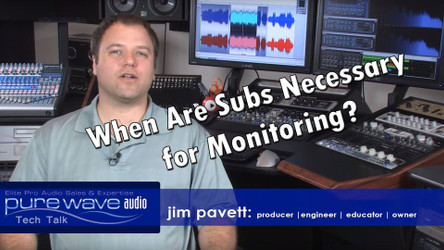
To Subwoofer or Not — Studio Monitor Extension Explained
Posted by Jim Pavett on 18th Jul 2025
The subwoofer question comes up constantly in studio monitor conversations. Do you need one? Will it help or hurt your mixes? Is it worth the investment?
The answer becomes straightforward once you understand what a subwoofer actually does in a studio context — and what it does not do.
What a Studio Subwoofer Is For
In a studio environment a subwoofer has one job: extending the frequency range of your existing monitor system below what your main monitors can reproduce accurately.
That is it. It is not a home theater subwoofer adding boom and impact to movie explosions. It is a precision tool that fills in the low frequency information your main monitors physically cannot reproduce — giving you an accurate picture of what is happening in your mix below their rolloff point.
The 40 Hz Myth
Most engineers assume that if their monitors spec down to 40 Hz they have the low end covered. A few years ago that assumption was reasonable. Today it is not.
Modern audio specifications — across playback devices, streaming platforms, and production tools — now extend well below 40 Hz. Gear that used to roll off at 40 Hz now passes information down to 20 Hz and below. Your car stereo, your listener's Bluetooth speaker, their headphones — all of them are reproducing low frequency content that your monitors without a subwoofer are not showing you.
What you cannot hear you cannot control. If your mix has a problem below 40 Hz you will not find it until you play your mix in a car, on a consumer system, or anywhere with real low end extension — and by then it is too late.
A properly integrated subwoofer eliminates that blind spot.
When You Need One and When You Don't
This is where the answer gets practical.
For critical listening — mixing, mastering, any session where you are making decisions about the final sound of a recording — I highly recommend adding a subwoofer. The accuracy of your low frequency reference directly affects every decision you make about bass, kick drum, low end balance, and how your mix translates to other systems.
For composing, tracking, or casual late night work — especially in situations where low frequency energy would travel through walls and disturb others — turn the subwoofer off or skip it entirely. In those applications you are not making critical mix decisions. You are creating and capturing. The subwoofer adds nothing to that workflow and potentially causes problems with your neighbors.
The ability to switch your subwoofer in and out of your monitoring chain is actually a feature worth planning for — a good monitor controller with subwoofer management gives you that flexibility without rewiring anything.
What PWA Carries
Focal makes three subwoofer options that integrate seamlessly with their studio monitor lineup:
Focal Sub One — the flagship studio subwoofer designed specifically for professional mixing and mastering environments. Precise, fast, and accurate — this is not a consumer sub. It is a monitoring tool.
Focal Sub 12 — a high performance studio subwoofer for larger rooms requiring deeper low frequency extension and higher output capability.
Both are designed to integrate with Focal's Alpha Evo, Shape and ST6 monitor lines — the crossover points and phase alignment are engineered to work together as a complete system.
If you want to talk through which subwoofer is right for your monitors and room size, hit reply. Getting the crossover point and placement right matters as much as the subwoofer itself.