
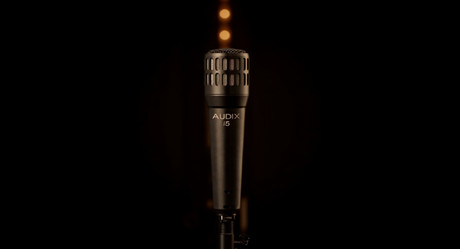
Dynamic Microphones — When Not to Reach for a Condenser
17th Aug 2026
I've been asked this question probably a thousand times over 40 years of commercial studio work — "Should I get a condenser or a dynamic?" And almost every time, the person asking already owns a condenser and is wondering why it isn't solving their problem.
Here's what no one tells you: the condenser microphone is not the default. It's not the professional choice. It's one tool in a large toolbox, and there are situations where reaching for it is the wrong call every single time.
What a condenser actually does
A condenser microphone captures everything. That is its strength and its liability simultaneously. The extended high-frequency response, the fast transient attack, the sensitivity — all of that works brilliantly in a controlled acoustic environment with a source that's worth capturing in that detail.
In a treated room, on a great vocalist, with proper gain staging — a condenser is remarkable. That same microphone in an untreated room will capture every flutter echo, every HVAC rumble, every reflection off your parallel walls. It doesn't know the difference between what you want and what you don't. It captures it all.
Where dynamics actually outperform condensers
A dynamic microphone has a slower transient response and a narrower frequency bandwidth. In certain applications that's not a limitation — it's exactly what the source needs.
Electric guitar amplifiers are the clearest example. The Shure SM57 has been on guitar amps in every major studio for 50 years. Not because engineers couldn't afford condensers — because the SM57's response curve complements the midrange character of a guitar amp in a way that a condenser's extended top end doesn't. A condenser on a loud amp can actually sound thin and harsh compared to a dynamic in the same position.
Loud sources in general favor dynamics. Kick drums, snare drums, brass instruments, screaming vocalists — these are sources where the output level exceeds what many condenser capsules handle gracefully. A dynamic doesn't flinch.
Untreated rooms favor dynamics. If your recording environment has acoustic problems — and most home studios do — a dynamic's tighter polar pattern and lower sensitivity will capture less of the room than a condenser. That's not always the answer to an acoustic problem, but it helps.
The question to ask before you pick up a microphone
What does this source actually need captured? If the answer is detailed, airy, extended — reach for the condenser. If the answer is punchy, focused, controlled — reach for the dynamic. The microphone is a filter. Choose the one whose characteristics serve the source.
If you want to understand how microphone selection actually works at the engineering level — not just which mic to buy but why different transducer types produce fundamentally different results — that's exactly what we cover in the Pure Wave Audio Academy. It's free to join.